The topic I automated my admin tasks with Claude Code and Cowork — here’s which one… is currently the subject of lively discussion — readers and analysts are keeping a close eye on developments.
This is taking place in a dynamic environment: companies’ decisions and competitors’ reactions can quickly change the picture.
Cowork has been the tool doing most of my admin work since I’ve had a Claude Pro subscription. Anyone whose system easily turns into a mess they’ll “deal with later”, or whose folders need constant handling, should probably get on Cowork already.
But then Claude Code entered the picture for me. I’ve been avoiding it because of the coding-tool reputation, but turns out there’s a lot more sitting there for someone who just wants Claude to have access to their files. So the question I ended up with is which one is actually worth spending my time in, because I don’t love bouncing between tools if one can handle the whole job on its own…
Cowork launched back in January this year, and Anthropic just expanded it natively to mobile and web a few days ago. The pitch is that you hand Claude a task and it works across your files, folders, and connected apps until the job is done, so you don’t have to sit in a chat window and guide it through every step yourself. What’s interesting is the usage data Anthropic published alongside the mobile rollout. They looked at 1.2 million Cowork sessions from more than 600,000 organizations, and software development accounted for less than 9% of it. Business operations and content work dominated, demonstrating that while Cowork can be used for coding, it’s mainly used for knowledge work.
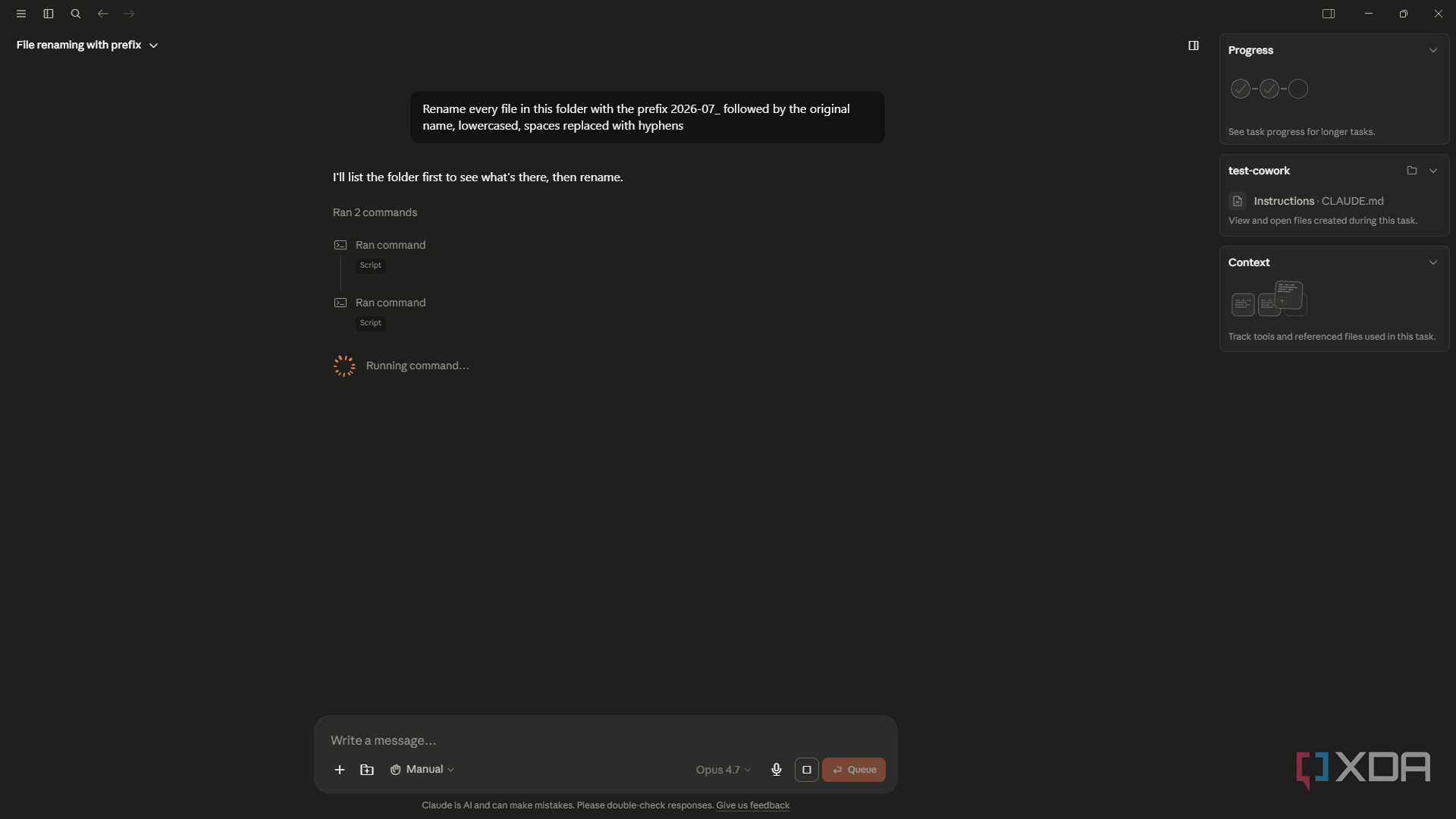
You point Cowork at a folder, it drops a CLAUDE.md file in there for the rules, and it goes off to do its thing without requiring you to sit there. Naturally, I set this up for file organization and it did a good job. So it was a nice bonus from a product I’ve already been paying for.
More recently I put it through a stretch of file admin to see how it holds up when the tasks get a bit more involved. First up was a batch rename across a folder with a consistent pattern, which it got through without any issues. Then I asked it to add frontmatter to a stack of markdown files, and it worked its way through them one by one without me having to open a single one. The one I was most curious about was a JSON restructure where every entry needed a new field, since JSON punishes small mistakes and I’ve had tools mangle these files before. But it handled that fine too.
What all that tells you is Cowork sits comfortably in the category of tasks where you can describe what you want once and leave it to its own devices. Anything with a repeating pattern across multiple files really, or anything you’d otherwise be doing the same tiny action fifteen times in a row for. It’s also fine with structured formats, which is pretty cool because those tend to punish sloppy edits. So for folder-level admin that follows a pattern, Cowork is the way to go.
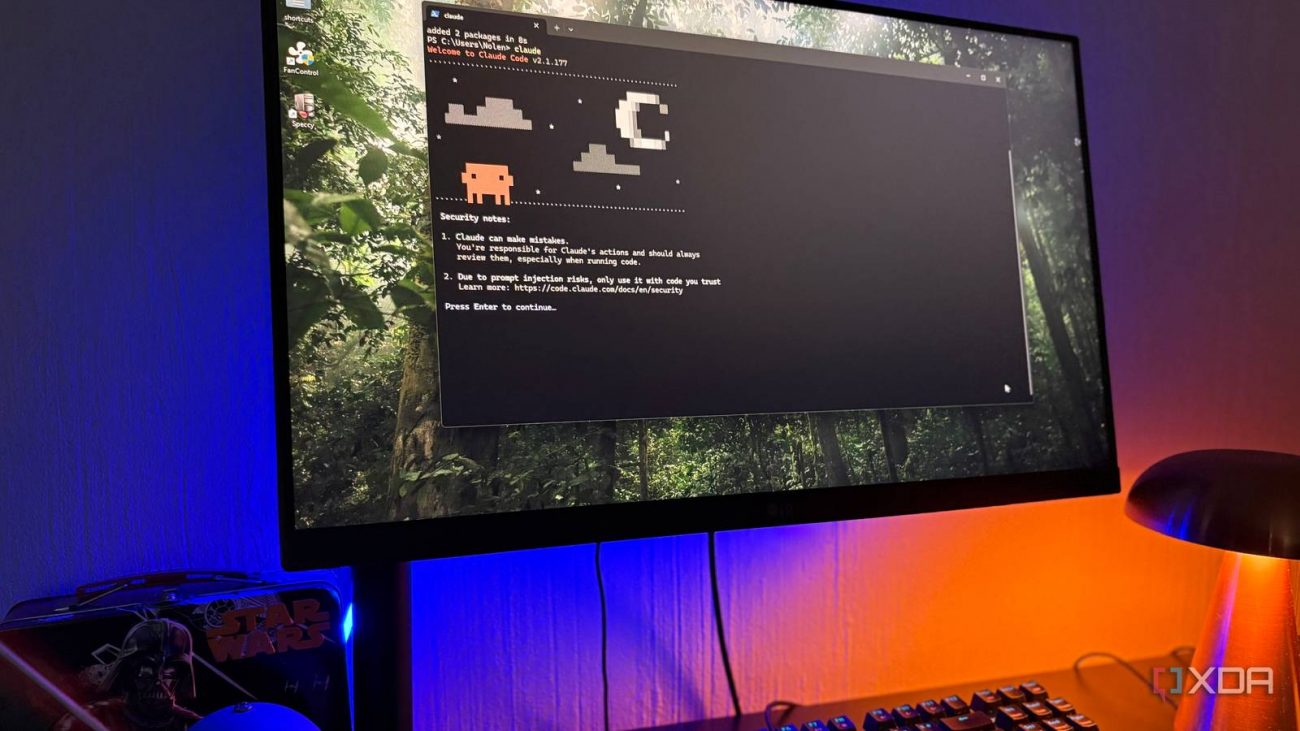
Claude Code is regular Claude with access to a folder. That’s the whole thing for a non-coder. You point it at a folder when you start a session, and from there it can read what’s in there, edit files, create new ones, whatever you want. Most of the coverage features terminal workflows and codebases, which makes it look like Code is only for developers. But Claude Code in the desktop app changed that; it looks like regular Claude.ai or Chat, making it more approachable to those who don’t live in a terminal.
After finally giving Claude Code a shot and understanding its functionality beyond development workflows, I started handing it tasks that I used to give to Cowork. Fast forward to now, and it’s the first thing I open for most admin work.
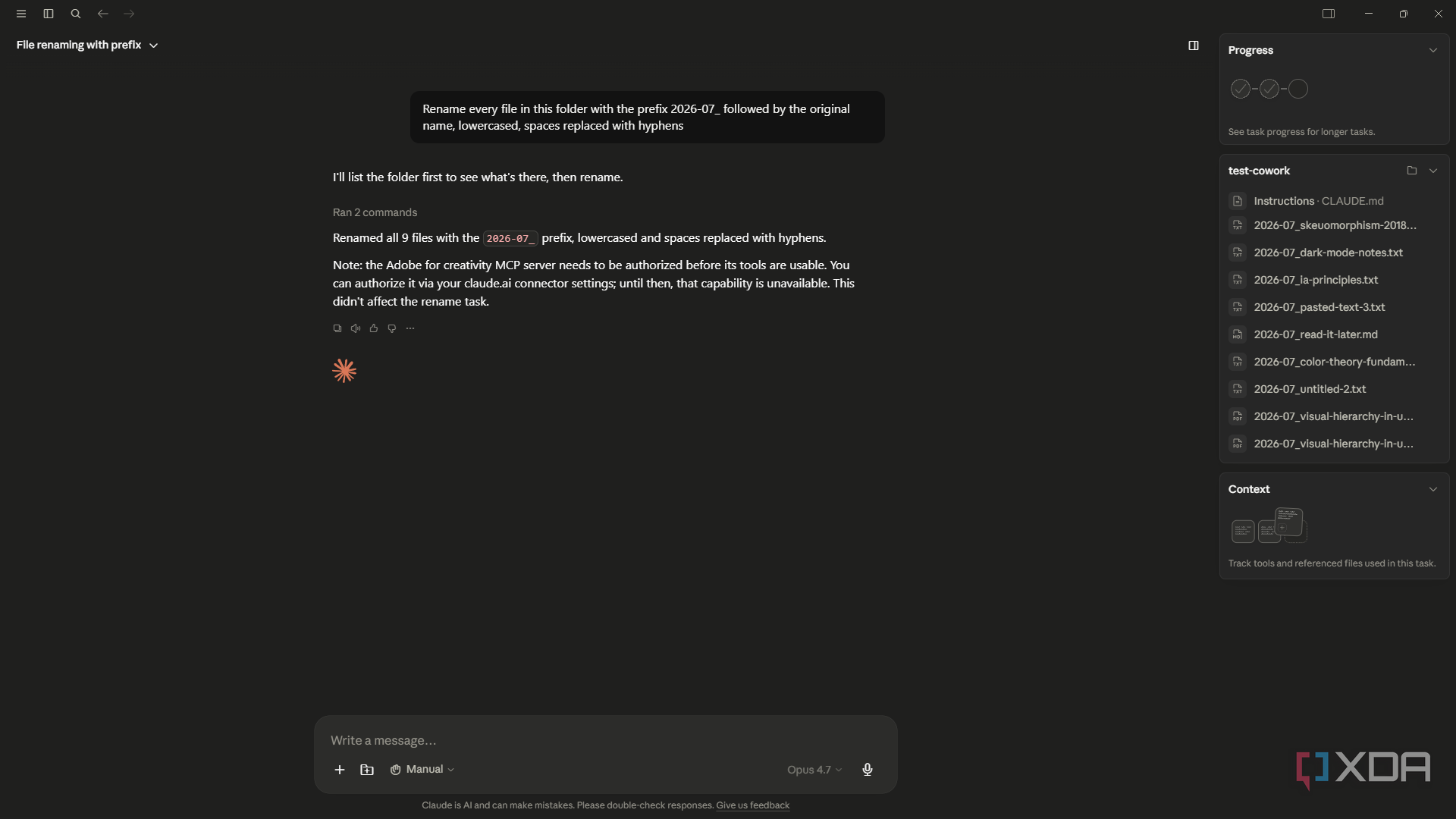
The first thing you notice is speed. Code just gets through tasks a lot quicker than Cowork does, so I stopped tabbing away to do other stuff while it worked. Both narrate what they’re doing, but Code narrates it a level deeper – you’re watching commands run and files open as it goes, and you’re sitting in the session with it. Cowork more so queues the task and reports back once it’s done. Feels a bit more like collaboration versus delegation.
That visibility does something for trust too. Because you can see every step Code takes, you can catch a wrong move before it commits to it. With Cowork you’re checking the work after the fact, so anything with structure that could break easily feels safer to hand to Code. And you can course-correct inside a Code session, which matters more than I thought it would. “Undo that last thing and try it this way” is a natural part of how Code works, whereas Cowork isn’t really built for that back-and-forth.
Claude Code became far more useful once I stopped treating it like a code generator and started using it to understand projects and terminal chaos.
Cowork has two things Code can’t match. The first is scheduling, so I can set a task to run on repeat without me kicking it off, like a nightly folder sort. The second is Dispatch, which lets you fire off tasks to Cowork from your phone. I actually use this to manage my Obsidian vault when I’m away from my PC, which has been one of the more useful things I’ve set up this year. And with the mobile and web rollout that just happened, Cowork now runs sessions in the cloud, so you can completely leave the device alone and everything keeps going. So for the “away from the desk” side of my workflow, Cowork just got even better.
Code’s edge is different. Skills are the big one; they’re reusable workflows you can trigger by name. Instead of describing a task from scratch every time, you call the Skill and it runs the whole thing. I’ve built a few by now, including one for keeping track of article pitches, one for meeting notes, and more recently also a prompt library skill I built out of a session where Code assessed my LM Studio chats. That last one was a major productivity win because it basically turned a massive and messy folder of JSON files into something I can actually query. Sub-agents are the next step up from Skills; they’re delegated assistants with their own context windows, and I can see the potential for parallelizing work you’d otherwise queue up serially.
Claude Code is the one that stuck. But that doesn’t mean Cowork is out. Cowork still handles a few nightly tasks I gave it to run on an automatic schedule, and I’m excited to play around with the mobile rollout. But for the types of files and workflows I actually have, Code has become a much better option. It’s just faster and smarter.