Astronomers link an X-ray nebula to a pulsar-powered PeVatron, offering major clues to the origins of galactic cosmic rays.
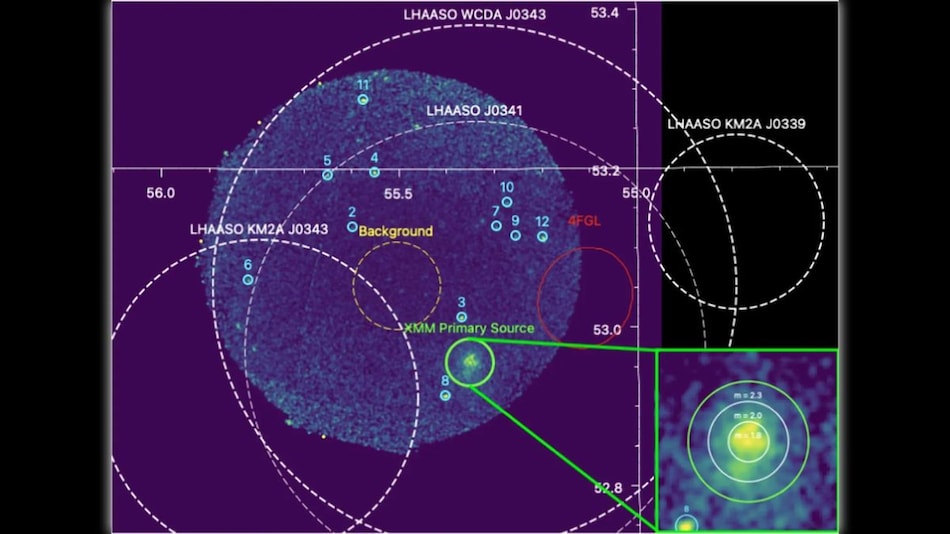
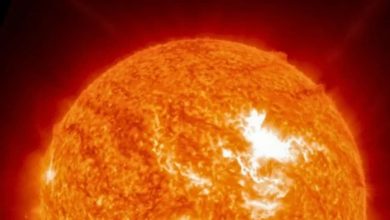
X-ray image of the newly discovered pulsar wind nebular associated with an extreme Galactic cosmic ray
Click Here to Add Gadgets360 As A Trusted Source

Galactic cosmic rays refer to high-energy particles that were discovered in 1912, although their origin has remained a mystery. The fact that China detected an X-ray nebula behind a source with its LHAASO observatory has led to new MSU observations of the X-ray nebula, which has been energised by a pulsar. This implies that the object is a rare PeVatron, which is a powerful cosmic accelerator capable of throwing the particles to massive energies. This finding brings astronomers a step closer to the solution to the hundred-year-old puzzle of cosmic rays.
Pinpointing a cosmic accelerator
According to the recent study published in The Astrophysical Journal, using XMM-Newton X-ray data, the team linked an unexplained LHAASO detection to a pulsar wind nebula – an expanding bubble of high-energy particles launched by a spinning neutron star. This confirms the object as a rare “PeVatron”, a powerful natural cosmic accelerator. It adds to LHAASO’s earlier discovery of about a dozen such extreme accelerators.
The broader hunt continues
Beyond X-rays, astronomers are using ‘multi-messenger’ probes. Last year, the IceCube neutrino observatory in Antarctica tracked a high-energy cosmic neutrino back to a distant blazar – the first time a cosmic accelerator outside our galaxy was pinpointed this way. Closer to home, IceCube has surveyed LHAASO’s dozen ultra-high-energy sources for neutrinos, finding none and setting limits on these Galactic accelerators.
Future studies will combine neutrino detections with X-ray and gamma-ray observations, as Zhang’s team plans, to finally solve the cosmic ray puzzle. For instance, a planned IceCube-Gen2 upgrade would dramatically increase sensitivity to such galactic neutrinos.