The topic Claude’s latest feature just made ChatGPT and Gemini obsolete for studying is currently the subject of lively discussion — readers and analysts are keeping a close eye on developments.
This is taking place in a dynamic environment: companies’ decisions and competitors’ reactions can quickly change the picture.
Large language models (LLMs) are changing the nature of productivity, and in the process, they have also reshaped the nature of research. The long-time front-runners ChatGPT and Gemini have their own merits in various tasks involving natural language processing, but Anthropic’s introduction of interactive visuals dethroned both in how immersive the learning process can become.
While the language models from both Google and OpenAI excel at displaying information in the form of visuals, Anthropic’s Sonnet 4.6 takes it a notch above by making that information truly interactive. For students and lifelong learners such as myself, this shift in user experience is what transforms information from digestible to something that can be actively explored, questioned, and understood.
I’ve always leaned on the scientific method when comparing things, both qualitatively and quantitatively, so I set up a simple test to see which model is the most conducive to the learning process. The prompt was as straightforward as I could make it: “Please interactively explain Thomas Young’s double-slit experiment.”
Now, I understand that the double slit experiment is anything but simple. It’s a landmark experiment in particle physics that established the wave-particle duality and continues to bear a challenge to intuitive reasoning to date. In a rather embarrassing admission, I will note that this concept took me a while to fully understand as a student in eleventh grade. That’s precisely what made this an interesting test. I wanted to observe how each model, including ChatGPT 5.4, Gemini 3.1 Pro and Claude Sonnet 4.6 would handle explaining something extremely abstract, which would normally take a reader at least a couple of hours to fully grasp.
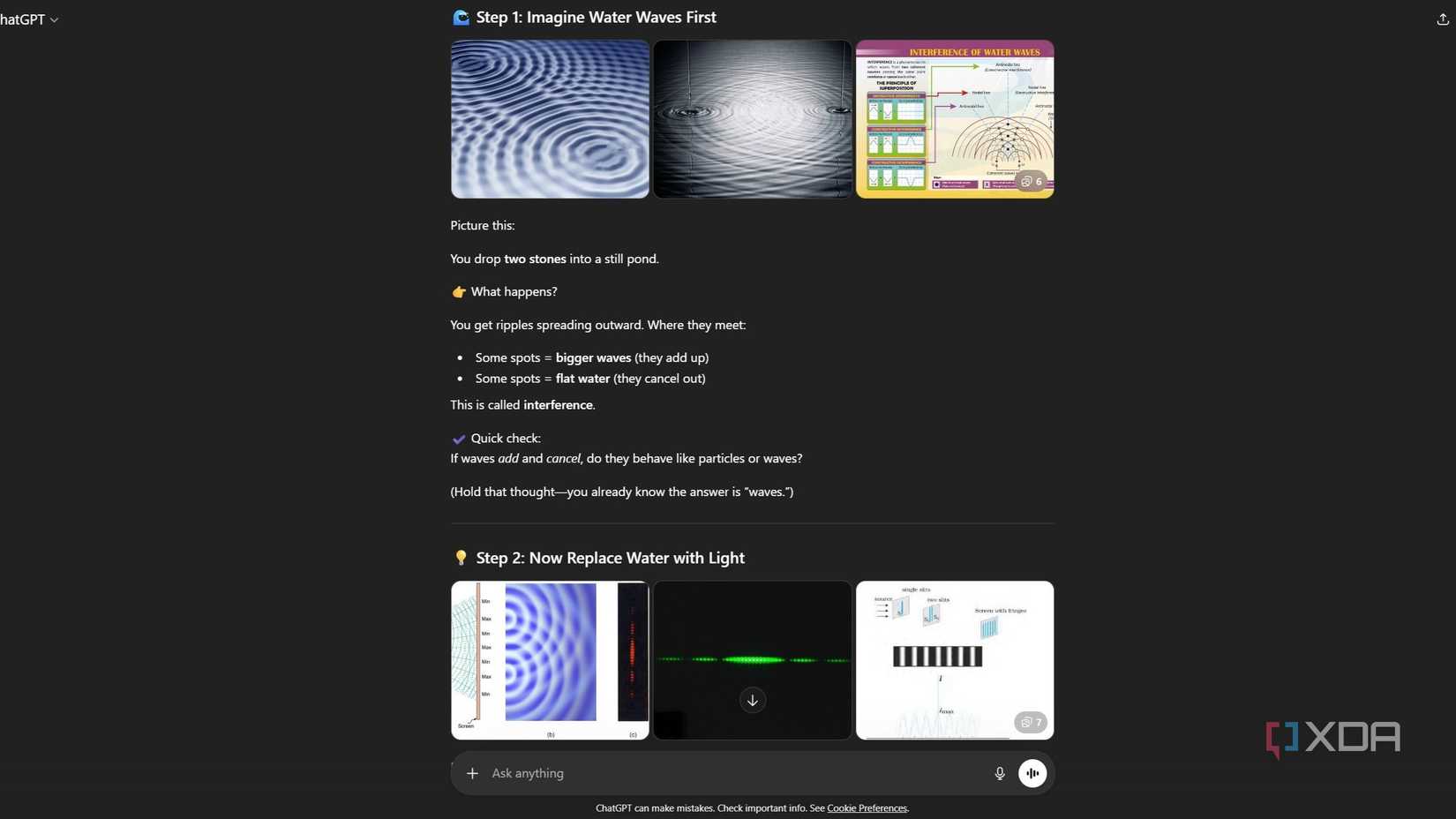
ChatGPT 5.4 did what was expected, and it broke the experiment into five labeled steps, each ending with a prompt nudging me to reason through the next idea myself. It opened with a water wave analogy, which is perhaps the most popular way of explaining the concept. I’d argue that this genuinely works well for the double-slit experiment (as it has been the teacher’s favorite for decades), but the formatting was rather emoji-heavy and visually chunked.
The charts and diagrams that OpenAI’s language model produced weren’t meaningfully different from what I’d find with a minute-long Google search or a YouTube tutorial. The information, although accurate and well-labeled, seemed to introduce the same cognitive load I had been looking to get some relief from.
Gemini’s response was, by a long shot, the weakest of the three. It followed a numbered structure and introduced the relevant formula, which at this point I realized ChatGPT never bothered with, so it certainly gets a point for that. Reading through the explanation, however, felt less like an interactive learning experience and more like cracking open a chapter from the very textbook I had been looking to run away from.
Perhaps the most vexing aspect of the entire experience was Gemini repeatedly asking me to imagine things. For a concept where the very act of observation physically changes the outcome, this indeed seemed like an unusual pedagogical choice. Needless to say, this was barely a step-up from the Wikipedia article documenting the phenomenon.
Claude’s response is what turned me into an advocate for ‘interactive visuals’ in learning. Sonnet 4.6 broke down the experiment into five sections, just as the experiment was structured, including the setup, wave behavior, the fringe pattern, the quantum twist, and the observer effect. Each section had animated visuals that sprung into life as I moved on, ending with a contextual prompt that invited me deeper into the experiment structure, neatly woven as if it were a story. This was the differentiator I had been waiting for all along.
Curious to see if Claude could interactively explain constructive and destructive interference, I followed up with another prompt. The model produced a dual-tab widget with live sliders for frequency, phase shift, and amplitude that changed the behavior of the resultant wave depending on the parameters.
Sure, one could argue that a YouTube video could have shown me the same thing, but it certainly couldn’t have let me experiment and play around with it. And perhaps that aspect of experimentation that makes it feel genuinely true to the scientific method.
While all three models were accurate in their respective explanations, Claude was able to make the learning experience more dynamic and interactive by making me an active participant in the learning process rather than a passive recipient, and perhaps that’s what makes all the difference when it comes to developing an understanding. My experience with Sonnet 4.6 goes to show that learning works better when it’s focused on exploration and interaction rather than information delivery, and that’s exactly where Claude has an upper edge right now.